


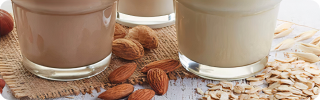


Plant milk has gone properly mainstream - sales keep climbing and it's now a genuine grocery category, not a niche. But most of the public conversation compares plant milk to dairy. Less talked about: how store-bought plant milk compares to the homemade version - and why that difference matters more than people realize.
The Additive Problem
Here's what nutrition research keeps surfacing about the plant milk on supermarket shelves: it's often more processed than people assume. Consumer nutrition experts have pointed out that many of these products go through heavy chemical processing, which in higher amounts can even cause digestive discomfort for some people. Cartons also typically rely on gums, stabilizers, and emulsifiers to keep the texture consistent for weeks or months on a shelf - additives that simply aren't necessary when you're making a batch to drink within days.
That's the core trade-off of store-bought plant milk: shelf stability, at the cost of ingredient simplicity.
The Fortification Gap
It's also worth being clear-eyed about nutrition. Plant milk is not a like-for-like nutritional substitute for dairy. University of Minnesota research covering more than 200 plant-based milks found that most - including almond and oat varieties - contain less calcium, vitamin D, and protein than cow's milk naturally. Manufacturers try to close that gap through fortification, but even fortified, most plant milks still fall short of dairy's protein content.
This isn't a reason to avoid plant milk - it's a reason to be intentional. If you're replacing dairy, knowing what you're not getting automatically (calcium, vitamin D, protein) helps you cover it elsewhere in your diet, rather than assuming the swap is nutritionally invisible.
Where Homemade Actually Wins
Making your own plant milk doesn't fix the fortification gap - a homemade oat milk still won't match dairy's calcium unless you add it yourself. But it does solve the additive problem entirely: no gums, no stabilizers, no shelf-life chemistry. Just the plant base, water, and whatever you choose to add.
It also changes the freshness equation. Store-bought cartons are formulated to survive weeks unrefrigerated or months chilled. Homemade milk is usually best within 3-5 days - which sounds like a downside until you consider that "shelf-stable" and "minimally processed" are, to some degree, competing goals.
The Sustainability Picture Is Genuinely Mixed
This is where nuance matters, because the environmental story isn't uniformly positive. Research generally finds plant-based milks have a lower environmental footprint than cow's milk in terms of greenhouse gas emissions and water use - with one notable exception: almond milk actually has a higher water footprint than either dairy or other plant milks, according to a University of Wisconsin-Madison study. So oat and soy milk tend to have a genuine sustainability edge; almond milk, less so.
Making plant milk at home adds another layer on top of that: it cuts out packaging waste per batch, the transport emissions from shipping heavy, mostly-water cartons, and the energy used in commercial processing. Journalists who've tried a month of homemade nut milk instead of store-bought have noted it addresses a footprint that even "eco-friendly" cartons still carry.
None of this means plant milk is "better" or "worse" than dairy - the honest, research-backed answer is that they're different foods with different nutritional profiles, and the right choice depends on your needs. But if you've already chosen plant milk, the format you get it in matters:
- Store-bought = convenience and shelf life, at the cost of additives and packaging.
- Homemade = ingredient control and less waste, at the cost of a shorter shelf life.
Making it yourself doesn't mean choosing between health-consciousness and convenience anymore - it just means knowing what you're optimizing for.